
Tangerine Holdings
Sustainable Aged Care Providers for Stronger Communities.
Tangerine Holdings
Elevating Cleaning Standards, One Space at a Time.
Our Objective
Tangerine Holdings is focused on acquiring profitable, community-trusted NDIS providers across Australia with strong compliance, stable participant bases, and sustainable operations. Our acquisition strategy ensures a respectful transition for owners seeking to exit, typically over a 12 to 24 month period. We are committed to maintaining the unique identity and service philosophy of each provider we acquire, while offering access to centralised support and resources. By operating under a decentralised model, we empower local teams and managers to retain their independence while continuing to deliver high-quality, person-centred care for participants.

Industry Overview
The aged care services industry in Australia is part of the broader health and community services sector and has experienced strong, sustained growth driven by a rapidly ageing population, rising government funding, and increasing demand for personalised, high-quality care. Providers delivering residential care, home care packages, and Commonwealth Home Support Programme (CHSP) services are central to ensuring older Australians can access safe, dignified, and consistent support. The sector is undergoing once-in-a-generation reform, creating significant opportunities for well-positioned operators to scale.
Profit Margin Profitability in the aged care sector varies by service type, provider size, and efficiency of operations. As of June 2024, 65.9% of residential aged care providers reported a net profit before tax — a meaningful improvement driven by increased government funding per resident. Well-run home care providers with lean operations and strong retention can achieve healthy margins in line with industry averages.
Enterprises The aged care sector encompasses thousands of providers nationally, though consolidation is accelerating. As of June 2024, there were 855 home care providers and 638 residential care providers — a decline of 0.7% and 3.0% respectively year-on-year. Not-for-profits dominate, accounting for 53.1% of the home care market and 55.8% of residential care, leaving a significant portion of the market in private hands and open to strategic acquisition.
As of 2024, the Australian aged care market is valued at over AUD $35 billion in residential services alone, with the broader sector — including home care and community support — exceeding $32 billion USD annually. The market is projected to reach USD $61 billion by 2033, growing at a CAGR of approximately 6.7%. Demand for reliable, compliant providers is expected to remain strong, underpinned by structural demographic shifts and sustained government commitment. By 2026, more than 22% of Australians will be aged over 65, up from 16% in 2020 — a direct and durable driver of sector growth.
New delivery models — including technology-enabled care management platforms, digital compliance systems, and centralised administrative support — are reshaping how providers operate. Families increasingly expect transparency, continuity, and high service quality, creating clear opportunities for efficient, well-run operators to scale. The introduction of the new Aged Care Act (commencing 1 July 2025) is expected to drive further market entry and consolidation as smaller providers face rising compliance requirements they lack the resources to manage independently.
Geographical Overview
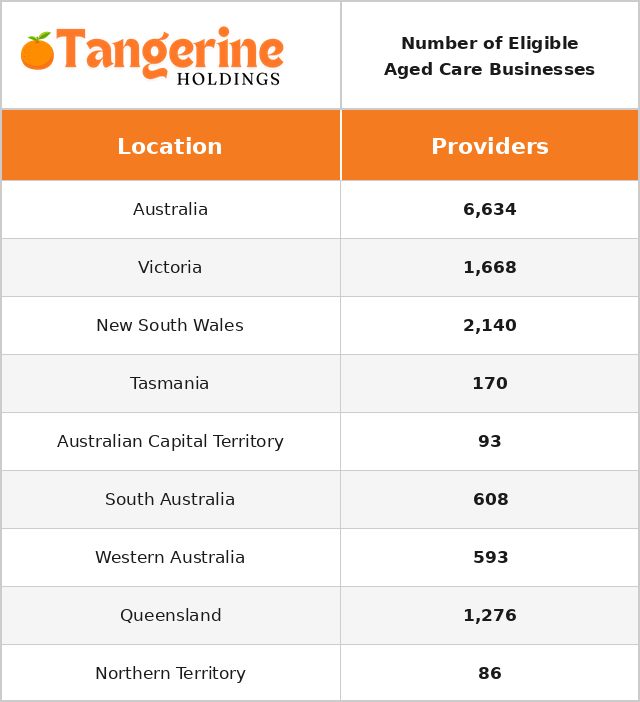
Tangerine Holdings’ acquisition strategy for expanding its presence in the Australian aged care sector is guided by a geographical overview that considers regulatory settings, client demographics, workforce availability, and demand for care services. While Tangerine Holdings is committed to a national footprint, it prioritises regions where the ageing population is growing rapidly, and the operational environment supports sustainable expansion.
Each state and territory presents distinct market conditions — shaped by residential care capacity, home care package demand, and funding dynamics. States like New South Wales, Victoria, and Queensland represent the most fertile ground for acquisitions due to their large and growing populations of older Australians, diverse service needs, and strong infrastructure for community-based care. These markets also have higher concentrations of smaller providers with loyal client bases but limited systems or capital to scale — creating compelling consolidation opportunities.
Conversely, smaller states such as South Australia or Tasmania present niche opportunities. Here, Tangerine Holdings may adopt a more selective strategy — focusing on long-standing providers with deep community ties and trusted reputations, but limited access to capital or modern care management systems.
By evaluating each region’s regulatory environment, demographic growth trends, workforce challenges, and funding patterns, Tangerine Holdings identifies high-potential regions for scalable growth. This targeted approach enables the group to standardise best practices across providers while retaining each business’s local identity and client relationships.
With the aged care sector continuing to expand nationwide and over 1.5 million Australians currently accessing government-funded aged care supports, Tangerine Holdings is well-positioned to build a sustainable national network — providing critical support to aged care providers while ensuring long-term impact for clients, families, and communities.
Business Strategy
Tangerine Holdings will focus on acquiring small to medium-sized aged care providers with strong community reputations and a stable client base. Ideal acquisition targets will generate between $500K–$5M in annual revenue with healthy EBITDA margins. We prioritise providers with experienced care teams, loyal clients, and demonstrated compliance track records. The introduction of the new Support at Home program (commencing 1 July 2025) is reshaping funding structures and increasing administrative complexity — placing significant pressure on smaller operators who lack the systems to adapt. This is creating a compelling acquisition environment, as many otherwise strong providers seek experienced partners or exit pathways. Each acquisition will undergo thorough due diligence to assess regulatory compliance, service quality, and operational standards. Post-acquisition, we will preserve each provider’s unique identity while introducing centralised support to improve efficiency, compliance, and long-term scalability.
We will invest in modern technology platforms to streamline client management, compliance reporting, rostering, and billing. The transition to Support at Home introduces new budget management requirements, service agreements, and quarterly reporting obligations that manual processes simply cannot sustain. By adopting centralised systems across acquired providers, we can reduce administrative burden, strengthen reporting accuracy, and improve service delivery transparency. Technology-enabled care management and automated compliance tracking will allow providers to operate at scale while maintaining client trust — turning what is a compliance cost for smaller operators into a competitive advantage for our network.
Our acquisition strategy targets regions with high concentrations of older Australians and demonstrated demand for aged care services. States such as Victoria, New South Wales, and Queensland are primary growth markets due to strong client volumes and funding allocations. Regional and rural areas — where workforce shortages and rising compliance costs are hitting smaller providers hardest — present particularly strong opportunities, as locally trusted operators increasingly seek partners with the capital and systems to help them survive the Support at Home transition.
Our goal is to build a sustainable, national aged care provider network that maintains local independence while benefiting from centralised systems and resources. The sector’s ongoing reform agenda — including the new Aged Care Act, Support at Home, and strengthened quality standards — is narrowing margins for smaller providers and accelerating consolidation. By acquiring these operators before distress sets in, we preserve continuity of care for clients, protect jobs for staff, and build a network capable of delivering consistent, compliant, and person-centred care at scale. Over time, our network will set the benchmark for quality and efficiency in the sector.
We will introduce centralised finance, HR, and compliance frameworks to reduce duplication and increase efficiency across providers. The Support at Home program demands a higher level of financial reporting, budget transparency, and service agreement management than many smaller providers currently have capacity for. Standardised operating procedures will ensure consistency across our network, while local teams continue delivering services that reflect community needs. Our execution model balances operational efficiency with respect for each provider’s established culture and client relationships.
We will invest in staff development programs to ensure high-quality, compliant, and person-centred service delivery across all acquired providers. Training will focus on the requirements of the new Support at Home framework, the strengthened Aged Care Quality Standards, and safeguarding obligations under the new Aged Care Act. Workforce retention is one of the most pressing challenges in the sector — and a key driver of margin erosion for smaller providers. By offering career development pathways, competitive conditions, and a stable operating environment, we aim to retain experienced staff across all acquired businesses and reduce the turnover costs that disproportionately affect independent operators.
Centralised marketing strategies will be developed to enhance provider visibility and attract new clients across home care and residential services. This includes optimised digital campaigns, GP and hospital referral programs, and community engagement initiatives. Many smaller aged care providers rely on word of mouth and have limited marketing capacity — particularly as the Support at Home program introduces greater consumer choice and comparison between providers. By consolidating resources, we will strengthen brand presence and client acquisition while maintaining each provider’s local identity and trusted community reputation.
Our acquisition model directly addresses the most pressing challenges facing aged care providers today, including:
- Reduced operating margins driven by Support at Home funding restructuring and rising compliance costs.
- Limited capacity to manage the administrative complexity of the new Aged Care Act and quarterly budget reporting requirements.
- Workforce shortages and high turnover rates that erode service quality and profitability.
- Lack of technology infrastructure to meet modern reporting and care management obligations.
- Inconsistent marketing and client acquisition strategies in an increasingly competitive, consumer-directed market.
- Owner fatigue and succession challenges among founding operators seeking a trusted exit pathway.