
Tangerine Holdings
Sustainable Childcare Providers for Stronger Communities.
Tangerine Holdings
Elevating Cleaning Standards, One Space at a Time.
Our Objective
Tangerine Holdings is focused on acquiring profitable, community-trusted childcare and early learning providers across Australia with strong quality ratings, stable enrolments, and sustainable operations. Our acquisition strategy ensures a respectful transition for owners seeking to exit, typically over a 12 to 24 month period. We are committed to maintaining the unique identity and educational philosophy of each centre we acquire, while offering access to centralised support and resources. By operating under a decentralised model, we empower local directors and educators to retain their independence while continuing to deliver high-quality early learning and care for children and families.

Industry Overview
The childcare industry in Australia is part of the broader early childhood education and care (ECEC) sector and has experienced steady growth driven by rising workforce participation, strong government funding through the Child Care Subsidy, and growing recognition of the importance of early learning. Long day care, family day care, preschool and kindergarten, and outside school hours care services are central to ensuring children can access high-quality education and care in the years before and during school. In the March quarter 2026, almost 1.48 million children from close to one million families attended a Child Care Subsidy approved service.
Profit Margin
Profitability in childcare varies depending on occupancy, staffing ratios, rent, and efficiency of operations. Well-run centres with strong occupancy and good quality ratings typically achieve sustainable margins in line with industry averages.Enterprises
As at July 2026, there were 18,197 approved services operating under the National Quality Framework. Close to 80% of approved providers run a single service, and many owner-operators have limited systems and resources, creating opportunities for roll-ups and consolidation into stronger networks.Employment
The sector employs more than 268,000 Australians, including early childhood teachers, educators, centre directors and cooks, and this number continues to grow as demand for early learning rises nationwide.
The Australian Government invests more than $14 billion a year through the Child Care Subsidy, with $3.59 billion paid in the March quarter 2026 alone. Average centre-based day care fees reached $14.50 an hour, up 4.3% year on year, and the introduction of the 3 Day Guarantee in January 2026 has further expanded access to subsidised care for families. Demand for reliable, high-quality providers is expected to remain strong, supported by structural government commitment and community need.
New business models, such as family engagement apps, digital enrolment and billing platforms, and centralised compliance and rostering systems, are reshaping the industry. Families increasingly expect transparency, communication, and consistent quality, creating opportunities for efficient, well-run operators to scale.
Despite regulatory complexity and workforce pressures, the industry presents strong roll-up potential. Many smaller centres have loyal families and long waitlists but lack the systems or capital to grow. By integrating them into a broader network while preserving their local identity, significant value can be unlocked.
The childcare sector is widely regarded as resilient and recession-resistant, underpinned by essential service delivery, government backing, and the lifelong importance of early learning.
Geographical Overview
Tangerine Holdings’ acquisition strategy for expanding its presence in the Australian childcare sector is guided by a geographical overview that considers state regulatory settings, population growth, household composition, and demand for early learning places. While Tangerine Holdings is committed to a national footprint, it prioritises regions where demand for places is growing rapidly, and the operational environment supports sustainable expansion.
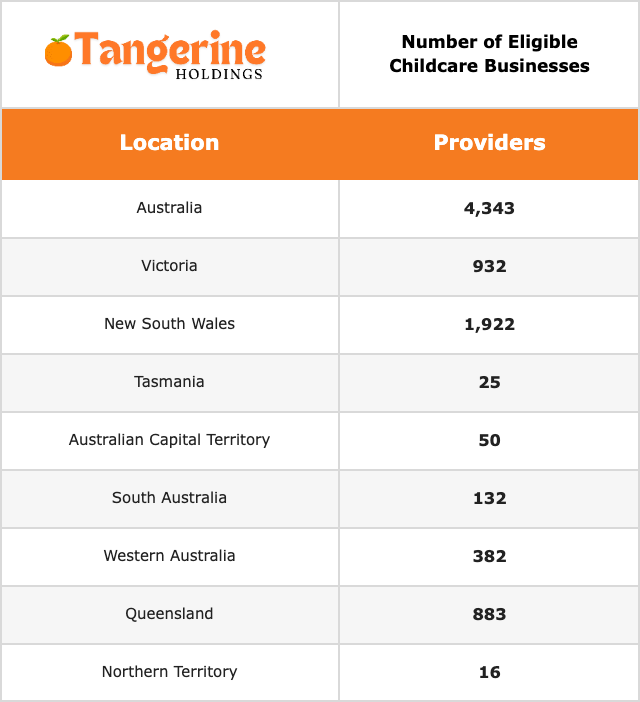
Each state and territory presents distinct market conditions, shaped by birth rates, new housing development, workforce availability, and state-based preschool and kindergarten funding. States like New South Wales, Victoria, and Queensland represent the most fertile ground for acquisitions, together accounting for around 80% of approved services nationally. Growth corridors in these states also have high concentrations of independent operators, creating opportunities for consolidation into stronger, better-resourced networks.
Conversely, smaller states such as Tasmania or the Northern Territory present niche opportunities. Here, Tangerine Holdings may adopt a more selective strategy, focusing on long-standing centres with deep community ties and loyal families but limited access to capital or technology.
By evaluating each region’s regulatory environment, population growth trends, workforce challenges, and occupancy patterns, Tangerine Holdings identifies high-potential regions for scalable growth. This targeted approach enables the group to standardise best practices across centres while retaining each service’s local identity and family relationships.
With 18,197 approved services nationwide and 92% of rated services meeting or exceeding the National Quality Standard, Tangerine Holdings is well-positioned to build a sustainable national network, providing critical support to childcare owners while ensuring long-term impact for children, families and communities.
Business Strategy
Tangerine Holdings will focus on acquiring small to medium-sized childcare providers operating one to ten services, with strong community reputations and stable occupancy. Ideal acquisition targets will generate between $500K–$5M in annual revenue with healthy EBITDA margins. We prioritise centres rated Meeting or Exceeding the National Quality Standard, with experienced directors, loyal families, and strong compliance track records. Each acquisition will undergo thorough due diligence to assess regulatory compliance, quality ratings, occupancy, and lease terms. Post-acquisition, we will preserve each centre’s unique identity while introducing centralised support to improve efficiency, compliance, and long-term scalability.
We will invest in modern technology platforms to streamline enrolments, Child Care Subsidy administration, rostering, billing, and family communication. By adopting centralised systems across acquired centres, we can reduce administrative burden on directors, strengthen reporting accuracy, and give families greater visibility of their child’s learning and development. Technology-enabled operations allow educators to spend more time with children and less time on paperwork.
Our initial focus will be on metropolitan and growth-corridor markets in New South Wales, Victoria, and Queensland, where demand for places is strongest and independent operators are most concentrated. Over time, we will expand into regional centres and smaller states where well-established services have loyal families but limited access to capital, building a national network with strong local roots.
Our long-term goal is to build a network of high-quality early learning centres that improves outcomes for children, supports working families, and provides secure, rewarding careers for educators. By strengthening the operational foundations of each centre, we aim to ensure every service we acquire remains a trusted part of its community for decades to come.
We will centralise back-office functions such as finance, payroll, Child Care Subsidy administration, compliance, and procurement, allowing centre directors to focus on children, families, and their teams. Standardised processes and shared purchasing power will reduce costs and improve consistency, while each centre retains control over its educational program and day-to-day operations.
We recognise that educators are the heart of every centre. We will invest in ongoing professional development, clear career pathways, and qualification support for educators and teachers. By improving retention and supporting staff wellbeing, we can maintain the continuity of care that children and families value most, while meeting ratio and qualification requirements across the network.
Centralised marketing will support each centre to maintain strong occupancy through local digital campaigns, refreshed websites, and simple online enquiry and tour booking. We will preserve each centre’s local brand and reputation, while sharing best practices and data across the group to attract and retain families more efficiently.
Our acquisition model addresses common challenges faced by childcare providers, including:
Limited access to capital for growth, refurbishment, and compliance upgrades.
Administrative burden from Child Care Subsidy, enrolment, and billing processes.
Difficulty keeping pace with evolving regulations and quality requirements.
Inconsistent marketing and occupancy management.
Educator shortages, retention, and training gaps.
Owner burnout and the lack of a clear succession plan.
By solving these issues, Tangerine Holdings creates a stronger, scalable, and compliant provider network that can deliver sustainable long-term outcomes for children and families.